
I was recently passed a pointer to the MPEG-21 Media Contract Ontology (thank you Niall!). This post is a high-level summary of the very informative paper (linked above) by Víctor Rodríguez-Doncela, Jaime Delgadob, Silvia Llorenteb, Eva Rodríguezb and Laurent Boch.
The Media Contract Ontology (MCO) is an OWL ontology formalizing a vocabulary to represent business contracts in the media content industry. MCO contracts are RDF documents using that vocabulary.
The clauses in a contract are related to permissions, prohibitions and obligations (deontic expressions). These so-called “operative clauses” are modelled using an ontology and related to the natural language.
A complex statement defining some exchanged rights, with conditions, on some content or service is also named hereafter an “operative clause”, as it defines in which operative context a given action is allowed, prohibited or obligated. The set of operative clauses is called the “operative part” of the contract. The fulcrum of an operative clause is the “deontic expression”, which encompasses the concepts of permission, prohibition and obligation. As the parties freely agree on the terms of the contract, they actually exchange the promise to respect the rules they defined in the operative clauses.
https://upcommons.upc.edu/bitstream/handle/2117/84008/paper-subir-upccommons.pdf
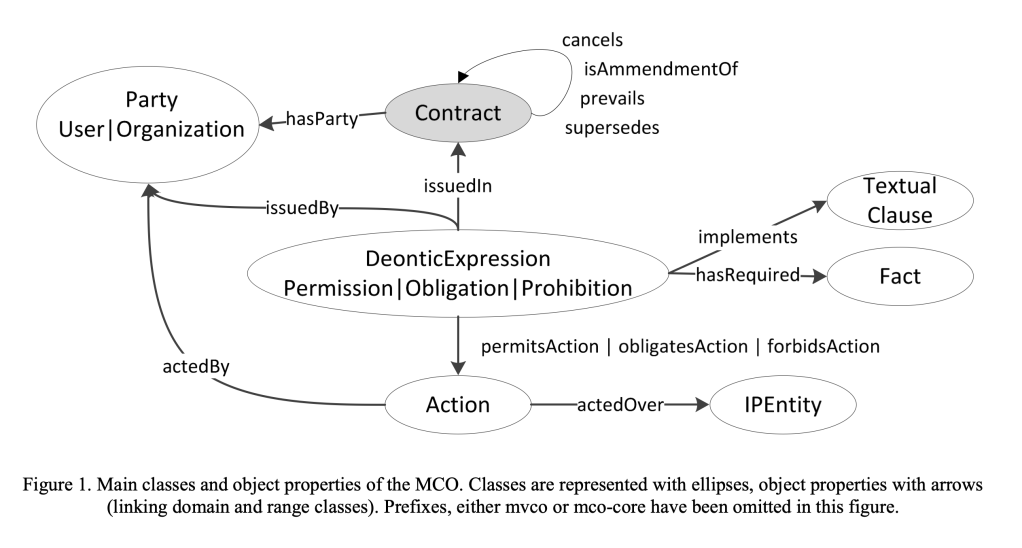
An OWL2 ontology is defined that relates Parties, Contracts and Clauses:
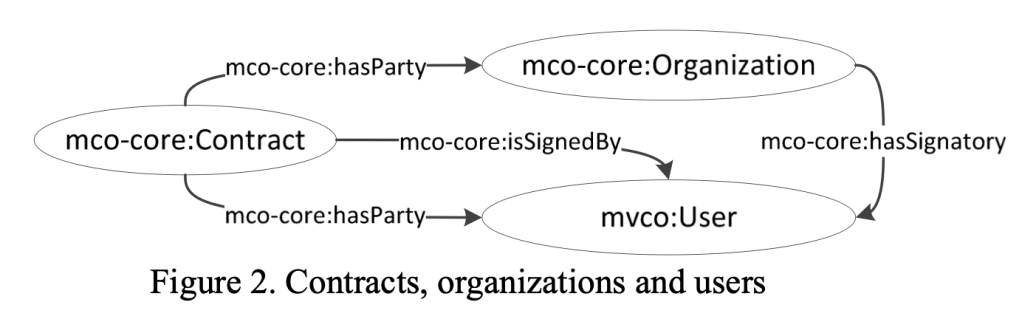
As well as information about who signed a contract:
The process of transforming a source contract to its machine-readable representation is manual, though assisted by various software tools.
MCO can be used for representing pre-existing narrative contracts. The process of converting a textual contract into an electronic contract starts with an analysis that identifies the most important terms in the contract and the related deontic elements. Each of the permissions, obligations, and permissions is translated one by one, irrespective of the number of clauses it was spanning in the textual version. Each deontic expression can point to the precise narrative text excerpts which it implements. In addition, the complete textual version can be embedded in the MCO contract.
https://upcommons.upc.edu/bitstream/handle/2117/84008/paper-subir-upccommons.pdf
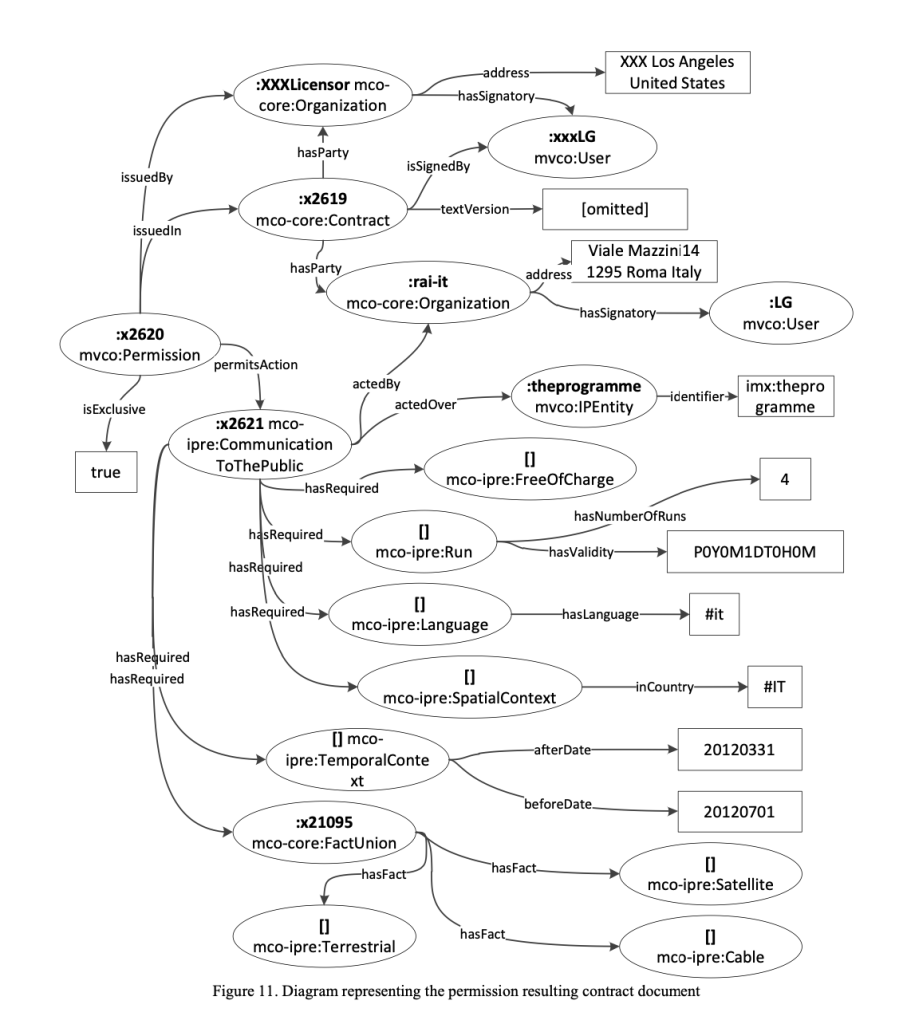
The result is an ontology similar to that below. It defines a exclusive Permission to broadcast a specific programme (IP entity) in a specific language (Italian) in a country (Italy) between two dates…
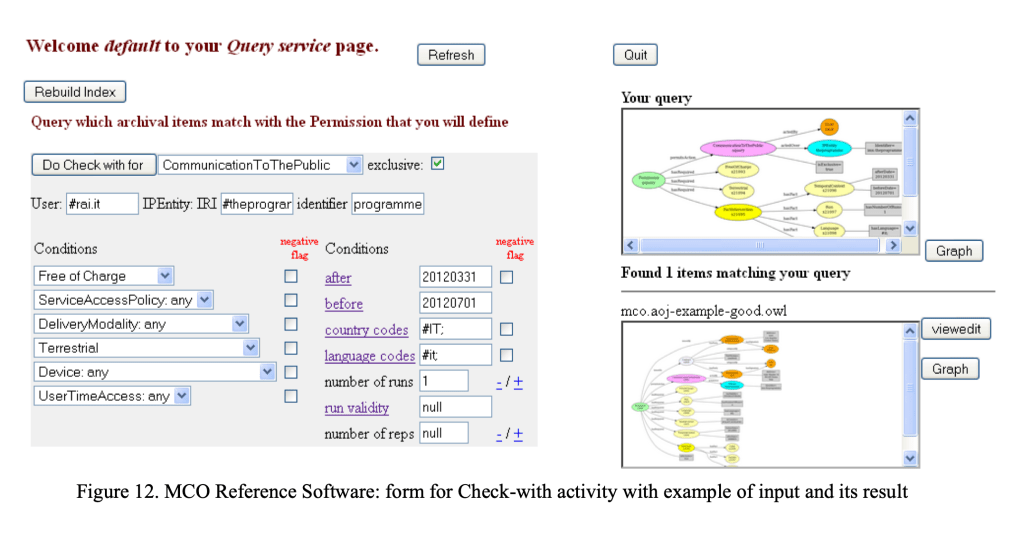
These rich ontologies can then be used for query and reporting purposes.
 Innovation That Matters
Leave a comment